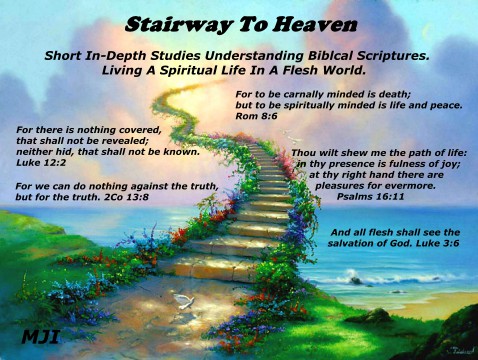
Heaven And Hell
The word “hell” is mentioned in the New Testament 23 times. Heaven is mentioned over 230 times in the New Testament.
Mat 5:29-30 And if thy right eye offend thee, pluck it out, and cast it from thee: for it is profitable for thee that one of thy members should perish, and not that thy whole body should be cast into hell. And if thy right hand offend thee, cut it off, and cast it from thee: for it is profitable for thee that one of thy members should perish, and not that thy whole body should be cast into hell.
Hell in the Greek (G1067); γέεννα Of Hebrew origin ([H1516] and [H2011]); valley of (the son of) Hinnom; gehenna (or Ge-Hinnom), a valley of Jerusalem, used (figuratively) as a name for the place (or state) of everlasting punishment: – hell. H1516 גַּי גַּיְא Probably (by transmutation) from the same root as H1466 (abbreviated); a gorge (from its lofty sides; hence narrow, but not a gully or winter torrent): – valley.
We can see from the definition of hell is in reference to a physical location on earth, or a state of being in reference to an earthly location. The scripture refers to the “body” being cast into hell, not the soul or spirit.
The verses with hell (G1067) are; (Mat 5:22, Mat 5:29-30, Mat 18:19, Mat 23:33, Mark 9:43, Mark 9:45, Mark 9:47, Luke 12:15, James 3:6)
The next definition of hell is G86.
Luke 16:23 And in hell he lift up his eyes, being in torments, and seeth Abraham afar off, and Lazarus in his bosom.
Hell in the Greek (G86); G86 ᾅδης From G1 (as a negative particle) and G1492; properly unseen, that is, “Hades” or the place (state) of departed souls: – grave, hell. G1492 εἴδω A primary verb; used only in certain past tenses, the others being borrowed from the equivalent, G3700 and G3708; properly to see (literally or figuratively); by implication (in the perfect only) to know.
Hell in these verses have the meaning of hell being unseen place, or state of departed souls. Hell as well as heaven is a state of being. How can you have a physical location outside of space?
The verses with Hell (G86) are; (Mat 11:23, Mat 16:18, Luke 10:15, Luke 16:23, Acts 2:27, Acts 2:31, Rev 6:8, Rev 20:13-14)
There is only one verse with Hell (G5020);
2Peter 2:4 For if God spared not the angels that sinned, but cast them down to hell, and delivered them into chains of darkness, to be reserved unto judgment;
Hell in the Greek (G5020); G5020 ταρταρόω From Τάρταρος Tartaros̄ (the deepest abyss of Hades); to incarcerate in eternal torment: – cast down to hell.
Heaven in the New Testament;
Mat 5:20 For I say unto you, That except your righteousness shall exceed the righteousness of the scribes and Pharisees, ye shall in no case enter into the kingdom of heaven.
Heaven in the Greek; G3772 οὐρανός Perhaps from the same as G3735 (through the idea of elevation); the sky; by extension heaven (as the abode of God); by implication happiness, power, eternity; specifically the Gospel (Christianity). G3735 ὄρος Probably a from an obsolete word ὄρω orō (to rise or “rear”; perhaps akin to G142; compare G3733); a mountain (as lifting itself above the plain). G142 αἴρω A primary verb; to lift; by implication to take up or away; figuratively to raise (the voice), keep in suspense (the mind); specifically to sail away (that is, weigh anchor); by Hebraism (compare [H5375]) to expiate sin.
Hell is in reference to the flesh, a flesh location, whereas, heaven is in reference to a “spiritual” location.
The word everlasting is found in 26 verses and the Greek definition is;
G166 αἰώνιος From G165; perpetual (also used of past time, or past and future as well): – eternal, for ever, everlasting, world (began). G165 αἰών From the same as G104; properly an age; by extension perpetuity (also past); by implication the world; specifically (Jewish) a Messianic period (present or future): (beginning of the, while the) world (began, without end). Compare G5550 χρόνος Of uncertain derivation; a space of time (in genitive case, and thus properly distinguished from G2540, which designates a fixed or special occasion; and from G165, which denotes a particular period) or interval; by extension an individual opportunity; by implication delay.
In this definition we see that “everlasting” in the 26 verses is in reference to the world, and not of anything related outside of time.
1Ti 4:8 For bodily exercise profiteth little: but godliness is profitable unto all things, having promise of the life that now is, and of that which is to come.
MJI (LightWorker)
 Stairway To Heaven
Leave a comment